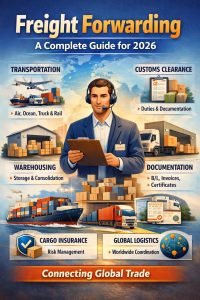
In the interconnected world of global trade, freight forwarding stands as the backbone of efficient logistics, bridging the gap between businesses and their customers across borders. But if you’re new to international shipping or looking to optimize your supply chain, you might be asking: What is freight forwarding? This comprehensive guide breaks down the definition, key functions, types, benefits, and 2026 industry trends of freight forwarding—designed to answer all your questions, boost your understanding of this critical logistics service, and help you navigate its landscape with confidence.
What is Freight Forwarding? A Clear Definition
Freight forwarding is the strategic coordination and management of goods shipment from a point of origin to a final destination. It involves working with multiple carriers—including shipping lines, airlines, trucking companies, and rail operators—to ensure cargo arrives safely, on time, and cost-effectively. Unlike carriers, freight forwarders do not physically transport goods themselves; instead, they act as trusted intermediaries between shippers (businesses or individuals sending goods) and the transportation providers that move the cargo.
According to FIATA (International Federation of Freight Forwarders Associations), freight forwarding encompasses a wide range of services related to the carriage, consolidation, storage, handling, and distribution of goods, as well as ancillary services like customs compliance and cargo insurance. In short, freight forwarders simplify the complex process of global shipping, turning logistical challenges into seamless solutions—making this service an indispensable asset for businesses of all sizes.
What Does a Freight Forwarder Do? Key Functions
A reliable freight forwarder offers end-to-end logistics support, handling every detail of the shipping process so businesses can focus on their core operations. For businesses relying on international trade, understanding the key functions of a freight forwarder is essential to leveraging this service effectively. Here are the most essential functions of a freight forwarder in 2026:
- Customs Clearance: Navigating complex import/export regulations, preparing required documentation (bills of lading, invoices, packing lists), and ensuring compliance with local laws—one of the most critical and time-consuming tasks in international shipping.
- Freight Consolidation: Combining smaller shipments into a single larger shipment to reduce transportation costs, a key benefit for small and medium-sized businesses (SMBs) with limited shipping volume.
- Carrier Coordination & Rate Negotiation: Leveraging established relationships with carriers to secure competitive rates and select the best transportation mode (air, ocean, road, rail) based on speed, cost, and cargo type.
- Risk Management & Cargo Insurance: Identifying potential shipping risks (damage, loss, theft, delays) and arranging cargo insurance to protect goods during transit. Freight forwarders also assist with insurance claims if issues arise.
- Shipment Tracking & Visibility: Using advanced digital tools and IoT sensors to provide real-time updates on cargo location, ensuring transparency throughout the shipping process—a top priority for businesses in 2026.
- Warehousing & Final Mile Delivery: Managing temporary storage for goods and coordinating last-mile delivery to ensure cargo reaches its final destination (warehouses, retail stores, or customers) efficiently.
Types of Freight Forwarding Services in 2026
Freight forwarding services are tailored to meet the unique needs of different shipments, with four primary types dominating the industry in 2026. Choosing the right type depends on your cargo size, urgency, budget, and destination—ensuring you get the most efficient and cost-effective solution for your shipping needs.
1. Air Freight Forwarding
Ideal for time-sensitive, high-value, or perishable goods (e.g., electronics, pharmaceuticals), air freight is the fastest mode of international shipping. In 2026, air freight forwarding is becoming more sustainable and cost-effective, with improved fuel efficiency and real-time tracking capabilities. It’s projected to dominate the market, accounting for 41.8% of global freight forwarding market share in 2026.
2. Ocean Freight Forwarding
The backbone of global trade, ocean freight is the most cost-effective option for large, bulk, or non-urgent shipments—making ocean freight forwarding a top choice for businesses shipping across long distances. It offers two main options: Full Container Load (FCL) for large shipments that fill an entire container, and Less than Container Load (LCL) for smaller shipments that share container space. Ocean freight forwarding also focuses on sustainability through energy-efficient shipping lines, aligning with 2026 industry trends.
3. Road & Rail Freight Forwarding
Road freight is critical for regional transport and last-mile delivery, offering flexibility for short to medium distances—key components of road freight forwarding. In 2026, road freight forwarding is evolving with eco-friendly vehicles and optimized route planning using GPS and telematics. Rail freight forwarding, meanwhile, is a growing choice for land-based long-distance transport, offering a balance of cost and speed with lower carbon emissions than road transport.
4. Multimodal Freight Forwarding
Multimodal freight forwarding combines two or more transportation modes (e.g., ocean + road, air + rail) to create a seamless shipping solution. This type is increasingly popular in 2026, as it leverages the strengths of each mode to optimize cost, speed, and reliability—perfect for complex global supply chains.
Why Do Businesses Need Freight Forwarding? Key Benefits
Whether you’re a small startup or a large multinational corporation, freight forwarding offers numerous benefits that simplify global shipping and drive business growth. Partnering with a reputable provider can transform your supply chain, and here are the top advantages in 2026:
- Cost Savings: Freight forwarders negotiate discounted rates with carriers and use consolidation to reduce shipping costs. They also help avoid hidden fees (e.g., customs penalties, storage charges) by ensuring compliance and efficient planning.
- Time Efficiency: By handling all logistical tasks—from documentation to carrier coordination—freight forwarders save businesses time and resources that can be invested in core operations. This is especially valuable for businesses new to international trade, which may lack the expertise to navigate complex shipping processes.
- Expertise & Compliance: Freight forwarders have in-depth knowledge of global shipping regulations, customs procedures, and trade laws. This expertise ensures shipments comply with all requirements, reducing the risk of delays or penalties.
- Risk Mitigation: With cargo insurance, risk assessment, and real-time tracking, freight forwarders help protect goods from damage, loss, or theft. They also provide guidance on packaging and labeling to minimize risks during transit.
- Global Reach: Freight forwarders have a network of carriers and partners worldwide, allowing businesses to ship goods to even the most remote destinations without building their own logistics infrastructure.
2026 Freight Forwarding Trends to Watch
The freight forwarding industry is evolving rapidly, driven by digital transformation, sustainability, and changing global trade dynamics. These trends are reshaping how these services operate, and here are the key ones shaping the industry in 2026:
- Digital Transformation: AI and automation are streamlining operations, with tools for AI-driven route planning, automated quoting, and real-time shipment visibility. Companies like DHL and Kuehne + Nagel are already using generative AI to enhance data management and customer support.
- Sustainability: Businesses are increasingly prioritizing eco-friendly shipping options, and freight forwarders are responding with green logistics solutions—such as carbon-neutral shipping, energy-efficient carriers, and sustainable packaging.
- Market Stability: After years of volatility, the global freight market is shifting toward greater stability in 2026, with container capacity growth outpacing demand. This creates a “buyer’s market” for shippers, with more predictable pricing and increased flexibility.
- Agile Supply Chains: Geopolitical shifts and trade policy changes are driving businesses to build more resilient supply chains. Freight forwarders are helping by offering flexible routing options and contingency planning to mitigate disruptions.
Final Thoughts: Is Freight Forwarding Right for You?
If your business ships goods domestically or internationally—whether small parcels or bulk cargo—freight forwarding is a valuable tool to simplify logistics, reduce costs, and minimize risk. By partnering with a trusted freight forwarder, you can leverage their expertise, global network, and digital tools to navigate the complexities of modern shipping, making this service a cornerstone of your supply chain success.
In 2026, as global trade continues to expand and logistics become more complex, freight forwarding will remain an essential component of successful supply chain management. Whether you’re new to shipping or looking to optimize your current process, understanding what freight forwarding is and how it works is the first step toward smoother, more efficient global trade.

