How does freight forwarding work in simple terms

Think about the last time you mailed a birthday card. You likely placed a stamp on the envelope, dropped it in a mailbox, and trusted the postal service to handle the rest. Now, imagine that “card” is actually a crate containing 1,000 bicycles, weighing over two tons, and it needs to travel from a factory in Taiwan to a warehouse in Chicago. Suddenly, the process isn’t just about dropping an item off; it becomes a complex puzzle involving trucks, cranes, massive ocean ships, trains, and strict government checkpoints.
Shipping a container across the world is not as simple as calling a delivery driver. It involves a mountain of paperwork, navigation through different time zones, and adherence to the laws of multiple countries. In practice, very few businesses own the ships or planes they use to move their products. Instead, they rely on a Freight Forwarder. This serves as a vital logistics overview for anyone new to the industry who wants to understand how products actually reach store shelves.
The senhu Agent analogy explains the role best. Just as a travel agent plans your vacation without flying the plane or owning the hotel, a freight forwarder plans the cargo’s journey without owning the ship. They are the architects of the trip. They use their industry connections to negotiate the best prices, book space on the vessel, and coordinate the schedule. In freight forwarding 101, the forwarder is the expert middleman who ensures all the separate parts of the journey connect smoothly.
Beyond just moving the box, these professionals handle the crucial administrative work. Like a tourist needs a passport to enter a foreign country, cargo needs specific legal documentation to clear customs. The forwarder ensures these “papers” are in order so the shipment doesn’t get stuck in legal limbo at the port. By managing this logistics coordination, they allow business owners to focus on selling their products rather than worrying about maritime routes.
Why You Need an ‘Architect’ for Your Cargo: Freight Forwarder vs. Carrier
Shipping a pallet of smartphone cases across the ocean involves much more than just finding a boat. Think of a freight forwarder as the architect of your shipping process. While an architect doesn’t physically pour the concrete or lay the bricks, they design the blueprints and hire the specific contractors to get the job done. This role stands in sharp contrast to the carrier, the company that actually owns the physical ships, planes, and trucks. The forwarder coordinates the entire journey, while the carrier provides the heavy machinery required to move the cargo.
Trying to book a single container directly with a massive ship owner often leads to frustration because their systems are designed for high-volume giants, not individual small businesses. Forwarders solve this problem by acting as Third-Party Logistics (3PL) providers. They function like a specialized travel agent for cargo, buying shipping space in bulk at a discount and passing those savings on to you. Because they bring thousands of clients to the table, they have the leverage to negotiate better rates and tighter schedules than you could ever get on your own.
Managing this journey yourself would mean juggling separate contracts for the truck that picks up your goods, the ship that crosses the ocean, and the train that eventually delivers them. A forwarder serves as your single point of contact, ensuring the complicated handoffs between these different vehicles happen smoothly. Once the physical logistics plan is set, however, the goods still need legal permission to enter a new country, which requires navigating the complex world of customs documentation.
The ‘Passport’ for Your Products: Navigating Customs without the Stress
Just as a tourist needs a passport to enter a foreign country, your shipment requires legal permission to cross international borders. Without the right “travel papers,” your cargo can’t simply drive off the dock; it will be held by government officials in what is effectively a port jail. This delay doesn’t just waste time—it accumulates daily storage fees that can quickly exceed the value of the goods themselves.
Navigating these government regulations is often the most stressful part of the process, which is why forwarders offer a specific service called Customs Brokerage. They act as legal translators who categorize your items correctly and calculate the necessary taxes. While you focus on selling the product, they ensure you aren’t accidentally breaking import laws or paying the wrong tariff rates.
To clear these checkpoints smoothly, your forwarder prepares and manages a packet of critical documents, typically including:
- Commercial Invoice: The official bill that tells customs how much the goods are worth.
- Packing List: A detailed inventory describing exactly what is in every box.
- Certificate of Origin: A notarized document proving where the product was manufactured to determine duty rates.
With the legal hurdles cleared and the paperwork filed, the next challenge is financial: how do you ship a small load without paying for the whole container?
Saving Money Through ‘Carpooling’: The Magic of Freight Consolidation
Imagine wanting to ship just two pallets of coffee mugs. Booking an entire 40-foot shipping container for that small load is like chartering a private jet for a solo weekend trip—technically possible, but financially ruinous. Most small businesses simply don’t have enough product to fill these massive metal boxes, which are designed to hold over 20 tons of cargo. If you had to pay for the whole container every time, international trade would be restricted to only the largest corporations.
Freight forwarders solve this capacity problem by using a strategy called consolidation. Think of this exactly like a morning carpool where neighbors share a ride to save on gas. Instead of five separate cars, everyone piles into one van. The forwarder collects your mugs, someone else’s t-shirts, and a third person’s electronics, stacking them together into a single container. You stop paying for the entire metal box and start paying only for the specific cubic meters your crates occupy.
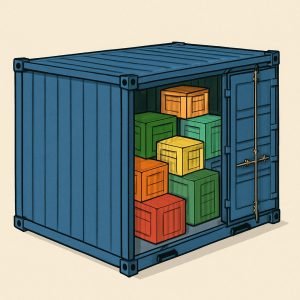
Logistics professionals call this shared method LCL, or Less than Container Load. It stands in contrast to FCL (Full Container Load), where one shipper rents the unit exclusively. While FCL is faster since the container doesn’t wait for other “passengers,” LCL makes trade accessible. It can turn a prohibitively expensive shipment into a manageable fee, allowing a boutique shop to import goods globally without breaking the bank.
By grouping these shipments, the forwarder transforms an unaffordable logistical nightmare into a routine transaction. However, coordinating this “shared ride” requires precise timing before the cargo even sees the ocean. Once the space is secured, the physical journey begins with the critical first step: getting your goods from the factory door to the port safely.
From Factory Gate to Ship Deck: The ‘Origin’ Journey Explained
Your goods are packed at the factory, but the ocean is likely hundreds of miles away. This first leg of the trip is known as Export Haulage. Think of it simply as the airport shuttle for your cargo. The freight forwarder usually doesn’t own the trucks; instead, they act like a general contractor, hiring a trusted local trucking company to pick up your pallets of smartphone cases from the manufacturer’s loading dock. This step ensures your products leave the factory floor and start moving toward the coast, handling the complex coordination so you don’t have to navigate foreign trucking schedules or language barriers yourself.
Once the truck arrives at the port city, it rarely drives straight up to the ship to drop off the boxes. Instead, the cargo is usually unloaded at a specific warehouse for Origin Handling. This is the staging area where the “carpool” actually assembles. Workers inspect your shipment to ensure it matches the invoice, check for any damage, and physically stack it into the steel container alongside other shipments. It serves as a critical safety check, ensuring that nothing dangerous or unaccounted for slips on board before the heavy doors are sealed shut.
Safely packed inside the metal box, the container is finally craned onto the massive ship, ready for the open ocean. However, physical movement is only half the battle; the ship’s captain will not accept the cargo without a specific legal “ticket” that proves what is inside and where it is going. This document acts as the receipt, the contract, and the title of ownership all at once. Before the ship leaves the harbor, every single box must be accounted for on the most important document in shipping: the Bill of Lading.
The Bill of Lading: Why This One Piece of Paper Is Your Cargo’s ‘Golden Ticket’
Imagine trying to board an international flight without a passport; you wouldn’t make it past the gate. In the world of logistics, the Bill of Lading (BOL) serves a similar function, but with much higher stakes. It is not just a packing list or an invoice; it is the ultimate “golden ticket” for your shipment. Without this specific document, the ship cannot legally carry your goods, and more importantly, the person receiving them at the other end cannot claim them from the port.
Because international waters are a legal gray area, the Bill of Lading has to do the heavy lifting of three separate legal documents combined into one:
- The Receipt: It proves the carrier (the ship) actually received your cargo and confirms it was in good condition when loaded.
- The Contract: It outlines the binding agreement to transport the goods from Point A to Point B for a specific price.
- The Title: This is the most critical part—whoever holds the original BOL legally owns the cargo.
Crucially, this document allows ownership to transfer while the ship is still in the middle of the ocean. If you are selling a container of coffee beans to a buyer in London, you don’t send them the beans directly; you courier them the Bill of Lading. Once they hold that paper, the goods are effectively theirs, even if the ship hasn’t docked yet. Now that your cargo has its legal paperwork in order, the next major decision is determining exactly how fast it needs to get there.
Choosing Your Vehicle: When to Fly, Sail, or Drive Your Freight
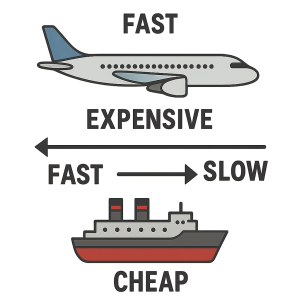
With the paperwork settled, you face a classic dilemma: do you prioritize speed or savings? Airplanes are the sprinters of the industry, capable of moving a pallet of electronics from Shanghai to Los Angeles in just a few days. However, that speed commands a premium price, often costing five to ten times more than the alternative. If your goods are perishable—like fresh flowers or the latest fashion trend—this high expense is a necessary investment to capture the market before it fades.
Ships are the marathon runners, carrying over 90% of the world’s trade because they offer unmatched economy. You might wait a month for a container of furniture to cross the ocean, but the cost per unit drops dramatically compared to air travel. This mode is the logical choice for heavy, non-urgent items where profit margins are tight. It requires better planning and patience, but for established businesses, the savings on the balance sheet are worth the wait.
Between these extremes lies the ground game. Trains and trucks often handle the final delivery or cross-continent trips, offering a middle ground in both price and speed. Beyond the budget, the carbon footprint is becoming a major factor in this decision; air freight generates significantly more emissions than ocean liners. Modern software provides a clear logistics overview to help weigh these options, allowing businesses to balance environmental goals while tracking international cargo shipments effectively.
Selecting the mode of transport is only step one. Once the cargo starts moving, you must clearly define where your responsibility ends and the buyer’s begins. A specific set of global rules exists to clarify exactly who pays for the shipping, the insurance, and the risk at every handover point.
Decoding the ‘Rules of the Sale’: Incoterms for the Rest of Us
Imagine buying a used sofa online. If you pick it up yourself, you are responsible for renting the truck and strapping the furniture down. If the seller delivers it, they handle the logistics and the risk of damage during the drive. In the world of global trade, these agreements are standardized into Incoterms (International Commercial Terms). These three-letter codes act as a universal shorthand, telling everyone involved exactly where the seller’s responsibility ends and yours begins.
Risk transfer is the invisible companion to physical movement. It is not just about who pays for the freight; it is about who takes the hit if a container falls off the ship or gets held up at a border. Choosing the right term prevents expensive arguments later. If you agree to take control at the factory door, you are the one filing the insurance claim if the truck crashes five miles down the road. Conversely, if the seller retains control until arrival, you can sleep soundly while they navigate the hurdles.
Incoterms for beginners are easiest to grasp by looking at the two extreme ends of the spectrum:
- EXW (Ex Works): The “Do It Yourself” option. You pick up the goods from the seller’s factory floor. You handle everything—trucks, ships, and customs—entirely on your own.
- DDP (Delivered Duty Paid): The “White Glove” option. The seller handles everything, including taxes and import fees, providing true door to door international shipping services.
Most businesses settle on a middle ground that balances control with convenience. Selecting the right term ensures you aren’t liable for a disaster halfway across the world, but it also impacts the final price tag. Once the rules of the road are set, you need to understand the financial specifics, particularly how to spot the extra charges that often go unnoticed until the invoice arrives.
Avoiding the ‘Hidden Fee’ Trap: What Really Drives Freight Costs
Just like an airline ticket where the base fare is rarely the final price, shipping invoices often include variable charges that catch beginners off guard. The most common addition is the Bunker Adjustment Factor (BAF), which is simply a floating surcharge for fuel. Large cargo ships consume massive amounts of oil, so carriers adjust their rates monthly to match global market prices, ensuring that unexpected freight forwarding costs and hidden fees don’t destroy their operating margins when oil prices spike.
Time becomes even more expensive than fuel once your goods actually arrive at the port. Because you are essentially renting the metal container your goods travel in, the shipping line wants it back immediately to use for the next customer. This leads to Demurrage and Detention fees, which work exactly like aggressive library fines. If your cargo sits at the dock past its allowable “free days” because of paperwork delays, or if you are slow to unpack and return the empty box, the carrier charges a daily penalty that can quickly exceed the cost of the shipment itself.
Professional coordinators help you dodge these penalties by preparing documents before the ship even docks, ensuring the cargo keeps moving. One of the significant benefits of using a freight forwarding service is having an expert who watches the clock so you don’t have to. While avoiding administrative fees protects your budget, you still need a dedicated shield to protect the actual value of your goods from physical damage or loss.
The Safety Net: Why Freight Insurance is Not Optional
Most first-time shippers assume that if a container falls into the ocean, the shipping line automatically pays for the lost goods. Unfortunately, maritime law limits a carrier’s liability to a tiny fraction of your cargo’s actual worth—sometimes just pennies per pound. Understanding these freight forwarding basics prevents a rude awakening, as standard transport contracts are designed to protect the shipping line’s operating margins, not your specific inventory.
You could even be billed for damage to other people’s cargo through a centuries-old rule called General Average. If a captain must voluntarily throw heavy containers overboard to save a sinking ship during a storm, every merchant with goods on board is legally required to split the cost of the lost items. Your shipment might arrive perfectly safe, but the port effectively holds it hostage until you pay your share of the collective “rescue” bill.
Securing a comprehensive policy is the only way to avoid these surprise costs. While carriers move the box, the question of who is responsible for freight insurance almost always falls on the business owner. Proper coverage shields your assets against standard liability exclusions, including:
- Acts of God: Severe storms, lightning strikes, or rough seas.
- Criminal Activity: Piracy, theft, or vandalism at the port.
- Civil Unrest: Damages caused by strikes or political turmoil.
With your financial risk covered, the final challenge is physically moving the goods from the crowded harbor to your front door.
From the Dock to Your Door: The Final Mile of International Trade
Once the ship safely docks at the destination harbor, the journey is surprisingly far from over. Your container is effectively stuck in a massive, high-security parking lot until it clears government customs and is physically craned off the vessel. Business owners monitoring their goods often find this stage the most frustrating; you might be monitoring the shipment online across the ocean, only to see the status freeze at “Arrived at Port” for several days. This pause occurs because the cargo must be processed and released by port authorities before a truck is legally allowed to pick it up.
Specialized short-haul trucking, known in the industry as drayage, bridges the critical gap between the ocean terminal and the nearest warehouse or rail ramp. Unlike the massive ship that carried thousands of containers efficiently, this stage requires individual attention for every single box to navigate congested city traffic. Freight forwarders coordinate these local drivers to ensure the service lives up to its name. Without this coordination, a container could sit at the dock accumulating daily storage fees simply because no truck was scheduled to retrieve it.
Successfully navigating this last leg determines whether your goods arrive on shelves on time or get delayed within sight of the finish line. A forwarder’s job is effectively complete once the truck driver hands over the delivery receipt, transforming a complex logistical web into a simple inventory arrival at your business. With the entire lifecycle from factory floor to front door now clear, the only remaining task is finding a partner capable of managing it all for you.
How to Choose Your First Freight Forwarder: A Checklist for Small Businesses
Now that you have a view behind the curtain of global trade, the chaotic world of shipping containers and customs forms should look much more manageable. You don’t need to memorize maritime law or learn how to drive a crane to ship your products globally. You simply need to recognize that international shipping is a team sport, and the freight forwarder is the captain you hire to lead the play.
Understanding what does a freight forwarder do for small business ultimately comes down to buying back your own time. Instead of spending your nights worrying about tariff codes or wondering if a truck arrived at a warehouse in Shanghai, you hand those logistics over to a pro. The true value of this service isn’t just about moving cargo from Point A to Point B; it’s about gaining the peace of mind to focus on growing your business while someone else navigates the borders.
However, finding the right partner requires a bit of diligence. Treat this relationship like a business partnership rather than a one-time transaction. Be wary of quotes that seem significantly cheaper than the rest. In logistics, a “too good to be true” price often hides surprise fees that appear only after your goods have left the dock. You are looking for transparency and communication, not just the lowest number on a spreadsheet.
To ensure you are hiring a forwarder who acts as a true partner, use this simple vetting checklist during your initial consultation:
- Network Strength: Do you have established agents in the specific country I am shipping to?
- Commodity Experience: Have you handled shipments for my specific type of product before?
- Technology: Do you offer an online portal where I can track my cargo in real-time?
- Insurance Clarity: Is cargo insurance included in this quote, or do I need to purchase it separately?
- References: Can you connect me with other small businesses you currently support?
Sending your first shipment across the ocean is a major milestone. It signals that your business is ready for the global stage. With the right “travel agent” for your cargo by your side, the world becomes a much smaller, more accessible place. You are ready to make the move.

